May 24, 2015

Wrangell - "The Friendliest Little Town in Southeast Alaska"

Tim and I thoroughly enjoyed our visit to Wrangell and would definitely recommend it as a worthwhile stop on the Inside Passage.  It’s a small town and is not widely known, and therefore feels more “authentic.”  Few cruise ships stop in Wrangell, and those that do are smaller in size.  Wrangell is a real working town, and it is not polished like some Alaska towns.  To me, it seems a bit earthy, or should I say, salty.  I like that.

Wrangell Harbor at Dusk

Wrangell certainly lived up to its reputation as “the friendliest little town in Southeast Alaska,” as Tim and I can attest.  It started with the manager at the ferry terminal and her staff, who went out of their way to help us find a place to get the RV repaired.  People on the street spoke to us, and a man sitting with his family at a restaurant started a conversation with us.

Even more remarkable, however, was the elderly couple that called out to us as we were walking back to the RV from downtown.  “Would you like a ride?” the woman asked us.  She wouldn’t take no for an answer, and we had the nicest chat on our way to the RV.  As we were getting out of the car, she gave us her telephone number and urged us to call if we needed anything at all.  That was a first for us, and it left us with such a nice feeling about the people of Wrangell.

In addition to our jet boat adventure, we found lots of things to keep us busy.  We seemed to find ourselves downtown for at least a little while every day and enjoyed walking by the boatyards.  We also visited the Wrangell Museum.  For such a small town, Wrangell has a very fine museum with an impressive collection that chronicles the history of the town and the Stikine River. 

Downtown Wrangell

Colorful Wrangell Harbor

Tlinget Basket Collection at Wrangell Museum

We also visited Shakes Island where the Chief Shakes Tribal House is located.  The Tribal House was recently restored and rededicated by local Native organizations.  Several totem poles once stood on the island but have recently been taken down.  We were still able to view the totems, which are now lying under the shelters while funding is sought for restoration or reproduction.

Chief Shakes Tribal House

On one morning we hiked to Rainbow Falls through the lush, old growth temperate rainforest.  The trail was less than a mile in length, one way, and mostly on a boardwalk surface.  The trail may have been short, but boy were there a lot of steps to climb.  The view of the falls and Shoemaker Bay was a nice reward.  

That's Just the Start of the Steps
Hemlock Forest


We then drove south on Wrangell Island to Nemo Point where we had lunch with a great view of the surrounding islands and Zimovia Strait.  There are several U.S. Forest Service campgrounds here, and many of the campsites share these views.

Nice Spot for a Picnic

Our favorite activity (excluding the jet boat ride!) was a visit to Petroglyph Beach.  This State Historic Site contains the largest concentration of rock art in Southeast Alaska.  There are more than 40 petroglyphs hidden among the rocks, and it is believed that at least some date back 8,000 years.  

Tim and I had a great time walking along the beach and searching for the carvings.  They were not so easy to find, even for an archeologist like Tim.  Once we found the first one, however, we seemed to more quickly spot others.  There were a few other searchers on the beach, and we enjoyed assisting each other.  Tim was especially helpful in pointing out the petroglyphs to the newcomers and offering insight into the stylistic differences.

Do You See This One?

Face Designs Like This Are Likely Older

Spirals Are Universal Designs

Other Finds at Petroglyph Beach

Look Closely Among the Rocks Here to Find Petroglyphs

On our last day, a cruise ship docked in Wrangell, and almost 500 passengers set out to explore the town.  We somehow managed to avoid the bus tours, even though we at times visited the same sites.  As we were leaving Petroglyph Beach, for example, two busloads pulled in.  Gee, that was close.  As it turned out, the ship was the Seven Seas Navigator, the same one Tim and I sailed on for our honeymoon.  It was actually sort of fun to see her again.  We certainly loved our Mediterranean cruise, and I’m sure that this Alaska cruise is one of the better ones offered.

Seven Seas Navigator Docked in Wrangell

May 22, 2015

Jet Boating on the Stikine River

When Tim and I first began to research the top things to do in Wrangell, a jet boat adventure on the Stikine River sounded like a lot of fun.  We had taken a jet boat ride in Hell’s Canyon during our nine-month trip, and we absolutely loved that one, so we booked the Stikine River Wilderness Adventure tour with Alaska Waters.  The fact that Alaska Waters offered a two-for-one deal with the Alaska TourSaver made the tour much more affordable.

The Stikine River is the fastest free-flowing navigable river in North America.  The river is 330 miles long and has its start in British Columbia.  The Alaska portion of the river is a part of the Stikine-LeConte Wilderness area, one of the most pristine areas in Southeast Alaska.

On a gorgeous morning Tim and I and three other couples boarded the jet boat at the dock in Wrangell and soon crossed the 17-mile-wide Stikine River Delta.  We traveled 70 miles up the river and into back-sloughs and tributaries before making our way toward Shakes Glacier.  The scenery was simply breathtaking, and we did our best to take in the high peaks of the Coast Mountains, the lush rain forest and the cascading waterfalls that we passed. 
   
The Stikine River Delta

Still Waters

Crystal Clear Water in the Tributaries

Snow-Capped Mountains and Rain Forests

A Most-Unusual Waterfall

Pristine Wilderness

More Waterfalls

On the way we stopped for a while to soak in the scenery, and our captain opened a cooler filled with Dungeness crab.  We knew that water and sodas would be provided, but this was his treat.  Wow!  James is the son of the owner of Alaska Waters and is a Native Alaskan.  He was an excellent guide and provided just the right amount of commentary without overwhelming us with information.  We especially enjoyed hearing the legends of the Tlingit people and how they arrived in Southeast Alaska.

When we made the turn toward Shakes Glacier, we were faced with an amazing sight.  Shakes Lake was filled with icebergs.  As we slowly made our way through the maze, we marveled at the crystal-clear ice and the blue tints.  We were so close that we could reach out and touch the ice.  Although the icebergs did prevent us from reaching the face of the glacier, that was ok.  This was a magical experience.

What Is That Floating in the Water?

Icebergs Blocking Our Way

Wonderful Shapes and Colors

Making Our Way Among the Icebergs

Floes of Ice

We pulled up to a nearby spit of land with a full view of the icebergs and were able to step out and admire the view.  No other boat was around, and we had the entire place to ourselves.  It was so quiet and peaceful.  Tim remarked that despite all of the backcountry he has explored, this was the most pristine wilderness he had ever visited.

Pretty Wildflowers

Our Jet Boat from Alaska Waters

An Iceberg Had Flipped Over Revealing a Gorgeous Blue

Final Look on Our Way Back

Unfortunately, the wildlife was shy, and we only spotted a few ducks and some harbor seals.  Not a moose or bear was to be found, and the bald eagle was not home in the enormous nest we saw.

A Few Harbor Seals Sunning Themselves

We have been fortunate to take two amazing tours so far, and we have several more planned.  Although you can have a fabulous time in Alaska without taking a flightseeing or boat tour, I would hate to miss out on these experiences.  While some may consider them touristy, I think they provide a look into a part of Alaska that you cannot see from the road or the trail. 

The big negative is that these tours are not cheap.  Most are way outside the entertainment budget of most full-time, or even part-time, RVers.  Yes, the Alaska TourSaver helps a lot, but even one tour is expensive.  My advice to anyone who is planning a future trip to Alaska is to start a special savings fund right now.  That’s what Tim and I did.  We put aside all of the fees that he’s earned from his contract work at national parks and labeled the fund “Special Alaska Experiences Fund.”  I expect that we’ll use every dime of it!

May 21, 2015

Rough Landing in Wrangell

We finally boarded the ferry in Ketchikan during a dense fog alert.  We had decided early on that it would be wise to book a cabin since we would be traveling overnight.  We found our cabin, and it was freezing inside.  Unfortunately, we discovered that there was no way to change the thermostat.  I was so tired and cold that I slept in my clothes to try and stay warm.

The Cabin Was Serviceable, But Cold

A Foggy Welcome to Wrangell

When we docked in Wrangell, we were curious to check our refrigerator and battery monitor.  We had left the refrigerator on battery power as a test of our new batteries.  During the six to seven hours of the trip we had used less than ten percent of our power.  Great!  That solves the problem of what to do with our food when we have to shut off propane on future ferry segments.

Our elation over the refrigerator soon turned to despair as we exited the ferry.  Tim drove the RV up the steep ramp, and we heard a terrible noise when he crossed the lip of the ramp onto the pavement.  He pulled into a parking space, and we got out to assess the damage.  The tanks seemed to be ok, which was a relief, but the door to our utility compartment was jammed shut and would not open.  Great, just great.  Not what we wanted to deal with in Alaska (or anywhere else for that matter).  We contacted the ferry personnel and informed them of the damage to our RV.  After a long wait, they began to fill out the paperwork.  We will have to file a claim with the State of Alaska, which should be a fun process.  NOT!

I Can't Believe the Lip Between the Ramp and Pavement Caused Such Damage

The manager of the Wrangell ferry terminal was extremely helpful.  Since we had no idea where we might be able to get a temporary fix in the tiny town of Wrangell, she called around, and John at Sitkine Auto Works told us to come right over.  Another terminal employee asked his friend to guide us to the shop, and we followed him through town.  We really appreciated the way in which these folks went out of their way to help us.

As John began to evaluate the damage, we knew we were in good hands.  There was more damage than we had originally suspected, and even the hinge was bent.  With a bit of brute force, many knocks with a hammer and a bit of Alaskan ingenuity, John had our door working.  It’s not pretty and the door will need to be replaced, but the fix should get us through the summer.  That’s important since that compartment is where our sewer hose and propane fill are located.  The most shocking thing is that John charged us only $50.  Many things may be more expensive in Alaska, but that was the lowest hourly rate we’ve ever paid for auto service. 

We Were in Good Hands Here

Why Won't the Door Open Any Farther?

It was early afternoon before we finally made it to our campground.  We are staying at Alaska Waters RV Park.  The campground is little more than a parking area for seven RVs, but it has full hookups and fast Wi-Fi and is nicely maintained.  There are even pots of pretty flowers at the base of each utility post.  Some of the other campgrounds in Wrangell may be more scenic, but this one serves our needs, especially since it is within walking distance of downtown.  An added bonus is that we were able to use an Alaska TourSaver coupon to get one free night.  A bald eagle also frequents a Sitka spruce tree next door.

All Alone at Alaska Waters RV Park

Alaska Waters is an Alaska Native business and is the same company that operates the Stikine River wilderness jet boat tour that we will be taking on Thursday.  A van will pick us up at the RV park and deliver us to the boat ramp.  It will be convenient not to have to move the RV and find parking downtown.

May 20, 2015

Final Days in Ketchikan

It seems that this is the summer for a huge number of RVers to make the journey to Alaska.  One couple is writing about their journey in the blog Coloring the Void, which I have begun to follow.  A recent post really hit home with me.  “The RV Life” perfectly captures what our RV life is also about.  The post describes the three types of days that comprise RV life – traveling, touristing and living.  Finding a balance between driving from one place to another, seeing the sights and performing routine chores and errands can often be challenging.  This is especially true for anyone making the journey to Alaska.

It’s tempting to try and see everything there is to see since we don’t know if, or when, we might be back to Alaska.  However, just like the rest of our full-time life, we have to remember to pace ourselves – this is not a vacation for us, it’s our life.  Although we may do more and go more than we are used to, we don’t want to burn out.  Sensory overload is not good either, and we certainly don’t want all the places to blur together.  We want to be able to appreciate every stop, even if it means we miss some things that are typical “must sees.”

It’s for this reason that Monday for us was a “living” day.  After our whirlwind day of flightseeing and touring on Sunday, we stayed around the RV, gazed out at the water, did a load of laundry, wrote a blog post and simply relaxed.  It was a perfect way to spend the day.  I’m so glad that we have several days between ferry trips to be able to see each town at a slower pace.

We took our time on Tuesday morning while checking out of the campground.  It was foggy and we were in no hurry.  We would be catching the ferry from Ketchikan to Wrangell, but it wouldn’t leave until 3:15 am.  Ugh!  Our plan was to spend the early part of the night camped at the ferry dock.

But before that we had two stops planned – Totem Bight State Park and Saxman Totem Park.  Both feature totem poles and clan houses, and they share a similar history.  In 1938 the Civilian Conservation Corp removed totem poles from abandoned villages and established totem parks, including those in Totem Bight and Saxman.  In most cases Native Alaskans working for the CCC duplicated the original totems using traditional methods.  The original poles were then discarded.  This program helped train a new generation of carvers and fostered an appreciation for Native art.

Totem Bight is a now a state park that recreates a model Native village.  A clan house, or community house, that is representative of the type built during the early nineteenth century is the centerpiece.  Fourteen totem poles surround the clan house, and a self-guided tour brochure describes the story behind each one.

Totem Bight State Park

Clan House

Main Entrance

A Beautiful Setting

Located within the context of a thriving Alaska Native community, Saxman Totem Park contains the largest number of standing totems in one location and includes examples of the best totem pole carvings in southern Southeastern Alaska.  Totem poles are strategically placed on both sides of the road that leads to the park-like setting that contains the clan house.  Most tourists visit Saxman on cruise ship tours, and we arrived just as two buses were about to depart.  We caught the tail end of a presentation by a young Tlingit carver and saw several totem poles that were in different stages of completion.

Approaching Saxman Totem Park

Clan House

That's an Odd Totem

Another Odd Figure

The Tradition of Carving Totem Poles Is Kept Alive at Saxman

It has been interesting to learn about the various types of totem poles, as well as their significance and the stories that they tell.  We especially enjoyed identifying the various symbolic characters that are represented and often repeated on the various totems.  The two totem parks provide a different experience than the one at the Totem Heritage Center, and I’m glad we decided to visit all three.
 
Stories and Symbolism

We spent the early evening in downtown Ketchikan after all the cruise ships had departed, and what a change it was.  Most of the shops were closed, and it seemed as if the town had rolled up the sidewalk.  It was then time to head to the ferry dock and try to catch a nap before it was time to board the ferry.  Easier said than done, but we survived. 

I still can’t believe the beautiful, sunny days we enjoyed in Ketchikan.  May is one of the best times to visit Southeast Alaska if you want to lessen the chance of rain.  It certainly worked for us.

I’d like to offer one last tip to any RVers who may be considering a stop in Ketchikan.  Before we arrived, we had read that campground water in Ketchikan contains tannins and is the color of tea.  Although the water is potable, it’s not what I wanted to run through our water filter or add to our fresh water tank.  So, we filled our tank before boarding the ferry in Prince Rupert and bought bottled water for drinking and coffee.  (We almost never use bottled water, but our tank is small and we would not have lasted without it.)  We will refill our tank when we get to Wrangell, our next stop.

May 18, 2015

Floatplanes, Forests and Totems

One of the things that Tim and I were most looking forward to during our visit to Ketchikan was a flightseeing tour of Misty Fjords National Monument.  Misty Fjords is an immense wilderness area just 22 miles east of Ketchikan and can only be visited by boat or plane.  Since we had just spent six hours on the ferry the previous day, we decided that a floatplane tour was the way to go.  Not only would we be able to grasp the immensity of the monument from the air, but we would be able to experience the sensation of landing and taking off from the water.  I absolutely love floatplanes and opt for one whenever that choice is available.

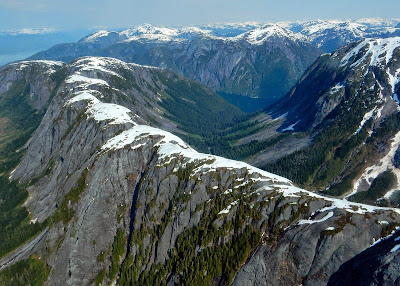
Misty Fjords was named for the almost-constant rainfall that is characteristic of the area, but it didn’t live up to its name for us.  We flew on a mostly sunny day with nary a raindrop in site.  It was a perfect day for flightseeing.  Soon after departure, we were flying over the deep fjords and sheer granite walls that rise directly from the water.  Thick forests of spruce, hemlock and cedar appeared as a green carpet from the air and provided a nice contrast to the snow-capped mountains.
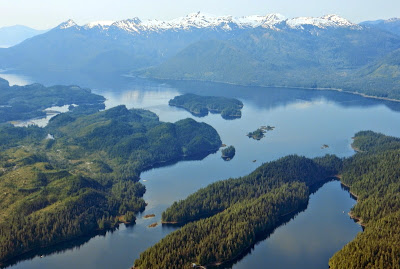
  
On the Way to Misty Fjords National Monument

Snow-Capped Peaks

Sheer Granite Walls

Glacier-Carved Bowls

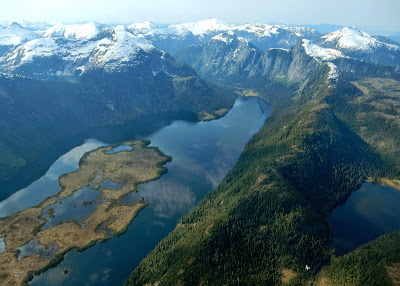
We spotted lacy waterfalls as they wound their way down the cliffs, fed by the streams and lakes that dotted the mountain tops.  About half way through the tour, our plane began to descend, and we soon landed on one of those jewel-like lakes.  At least for a bit, we were the only ones there in that incredible wilderness.  We were able to step out of the plane and onto the pontoons and admire the beauty that surrounded us.  That was a special moment.  Too soon, however, it was time for another floatplane to take our place, but it was wonderful while it lasted.
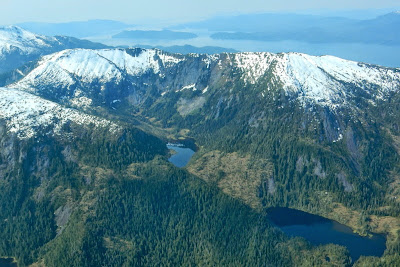
An Endless Wilderness

Forested Mountains

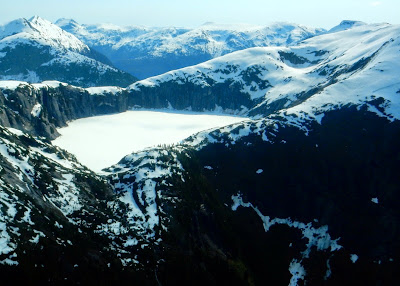
Frozen Lakes

Landing on a Lake

Time to Get Back in the Plane

We flew over the lake one last time and began to make our way back to Ketchikan.  We soon spotted Tongass Narrows, the waterway on which Ketchikan is located, and made a smooth landing back at the dock.  The flight was over way too soon, but what a blast it was!
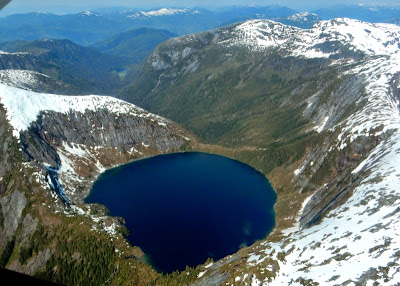
Jewel-Like Lakes

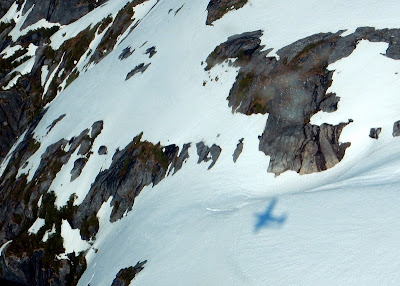
Our Shadow in the Snow

We Qualified for Our Alaska Bush Plane Certificates

Flightseeing is one of the most popular tourist activities in Ketchikan, and for a very good reason – it’s an amazing experience and one of the best ways to see the spectacular scenery of this area.  Numerous companies offer tours to Misty Fjords, but we flew on Taquan Air, which seems to offer the most flights.  I believe that five other planes took off at the same time we did.  Some of the smaller companies may offer a more personalized tour, but we were very pleased with our experience.

Why did we select Taquan Air?  It was simple – this was the only outfit that offered a two-for-one deal.  With tour prices around $269, that represented quite a savings.  How did we get this deal?  Before departing for Alaska, we purchased an Alaska TourSaver book that offers hundreds of coupons for tours, attractions and accommodations.  We had checked out the offers beforehand and decided that we would recoup the $99 cost of the book with just one or two uses.  We’re already ahead with the Misty Fjords tour, as well as the one free night offer we used at Clover Pass Resort. 

After our tour we made our way to downtown Ketchikan to see the town.  Since it was Sunday, we were easily able to find parking on the street.  We spent some time walking through the downtown area and tried to concentrate on the historic architecture, not the plethora of Caribbean jewelry stores that occupy the storefronts.  Is this really what cruise ship passengers want to purchase in Alaska?
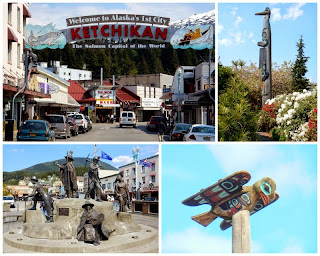
Downtown Ketchikan

My favorite area was Creek Street with its charming buildings constructed over the water.  This former red-light district now houses shops and restaurants, as well as Dolly’s House, a museum dedicated to the life of Ketchikan’s most famous madam.
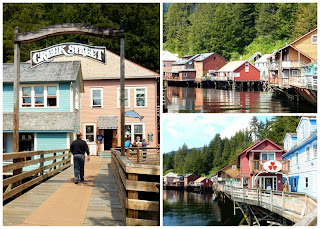
Creek Street

At lunch, we learned that the crowds would increase four-fold on Tuesday, with five cruise ships due in port.  More than 12,000 tourists would descend on the town of 8,000 residents.  And we thought it was crowded with just three ships in town!  With that bit of news, we decided to stay downtown and try to hit more of the sights that were on our list.

The hordes of cruise ship passengers that descend en masse is the biggest negative for independent tourists visiting towns along Alaska’s Inside Passage (I'm sure a lot of the cruise ship passengers are not especially fond of it either).  Thousands of people can overwhelm these small communities, and it is often hard to discover the true character of a town when you are fighting for a place on the sidewalk.  However, if you simply walk just a few blocks away from the main activity center near the piers, it is often more peaceful.  Even with three ships in port, we found streets to walk and places to visit where we encountered only a handful of other visitors.  Spending several days in each port is another way to avoid the busiest days.

One such stop was the Southeast Alaska Discovery Center, an interpretive center operated by the U.S. Forest Service.  We rested our legs a bit by watching one of the films, a very informative history of Ketchikan, and then toured the center.  The exhibits focus on the land, people and culture of the Tongass National Forest, the largest national forest in the United States.  We were impressed with the quality of the displays on the temperate rain forest, native traditions, ecosystems and natural resources.

Southeast Alaska Discovery Center

We next followed the very handy downtown walking tour that is mapped out in a brochure we had picked up at the visitor center.  Our destination was the Totem Heritage Center, the world’s largest collection of nineteenth century totem poles.  During our visit, only two other couples showed up.  Ketchikan is known for its totem poles, and you can find them scattered throughout the city.  All of these are new totems, or reproductions of original ones.  What makes the Totem Heritage Center unique is that it preserves and displays historic totem poles in their unrestored condition.

Totem poles are the most prominent symbol of cultural identity for the Northwest Coast Native peoples.  These icons were carved to honor important individuals and to commemorate significant events.  Carved from western red cedar, totem poles were designed to stand in place until they fell and were returned to the earth.  And that is exactly what happened to most of them as Alaska Natives moved from their villages to seek employment in Ketchikan and other towns along the coast.

Although some totem poles were sought out and salvaged by museums and collectors in the early twentieth century, it was not until the 1960s that a major effort was undertaken to survey and document those that remained.  With the permission of Native elders, the Alaska State Museum and the Alaska Native Brotherhood then began to retrieve abandoned totem poles in the 1970s, and the City of Ketchikan provided the facility to house them.  The stipulation was that the totems not be restored, but kept in the condition in which they were found.

Totem Heritage Center

The City of Ketchikan operates the Totem Heritage Center, which is also dedicated to preserving the cultural traditions that gave rise to the totem poles on display.  During the fall and winter, classes and workshops are taught in traditional arts and crafts in an effort to strengthen and perpetuate these traditions for future generations.  An exhibit at the center showcases the works produced by the students.  The quality of the objects makes me think that this artistic heritage is in good hands.