June 19, 2015

Cataloging Historic Photographs at Sitka National Historical Park

As I mentioned in previous posts, Tim and I worked at Sitka National Historical Park for the last three weeks.  Our project was to catalog and rehouse a collection of almost 1,000 glass plate photographic negatives that were recently acquired by the park.  We finished the project this afternoon, and we have to admit that we are very proud of what we accomplished.

First, let me give you a little background so you will have a better understanding of the collection itself.  Between 1897 and 1929 E. W. Merrill, who was known in Sitka as the “Father of Pictures,” produced thousands of photographs.  Merrill used large format cameras to create each negative, most of which were eight-by-ten inch glass plates, and he sold prints of his work in his shop in Sitka.  Appreciation of Merrill’s work has grown in recent years, not only for the history that he documented, but also for artistic value of the photographs themselves.

Merrill is also closely associated with Sitka National Historical Park.  He served as the first caretaker of the park from 1919 to 1922 and was instrumental in selecting appropriate locations for the totem poles for which the park is famous.  The park was also a favorite subject of Merrill’s, as well as a background for many of his photographs.

A Plaque Honoring E. W. Merrill

Our job was to catalog all negatives in the collection and store them in a more appropriate and archival manner.  This involved removing each negative from its existing sleeve, examining it on a light table, writing a detailed description of the image itself, assessing the condition of the plate and placing the negative in a new four-flap envelope that had been pre-folded and labeled with the catalog number.  All information about the negative was then entered into an extensive computer database.

Removing the Negative from Its Old Sleeve and Examining It on a Light Table

Placing the Negative in a Four-Flap Envelope

Storing the Negatives in New Archival Boxes

Tim was in charge of cataloging the information in the computer, and I was responsible for handling and rehousing the negatives and formulating an initial description. 

Cataloging the Data
Entering Every Field


Did you know that you have to wear latex or disposable gloves when working with glass plates?  I was a little intimidated to be dealing with such large and fragile pieces of glass, but I managed to get through without breaking or even chipping a single plate.  The already-broken plates were especially challenging to deal with.  Thank goodness there weren’t too many of those.

I Usually Use Disposable Gloves to Dump the Tanks, Not Handle Glass Negatives!

Broken Plates Were a Bit More Difficult to Handle

As a former museum curator for Rocky Mountain National Park, Tim is an expert at cataloging.  It doesn’t really matter whether the item is a glass negative, a piece of pottery or a legal document, the procedure is the same, as is the type of information that must be recorded.  This project, however, was a massive one, and I’m not sure we were quite prepared initially for the amount of work involved.

Soon after we started, we realized that we would have less than five minutes to spend on each negative if we were to finish the project in the original two weeks.  When the park’s museum curator indicated that her priority was quality (a more detailed description) as opposed to quantity (the number of plates cataloged), we determined that we could finish about two-thirds of the collection.  However, it bothered us to leave a job unfinished – we’ve always finished every project we’ve undertaken.  Luckily, the staff liked our work and asked us if we would be willing to stay an additional week.  Although that would cut into our time exploring Alaska, we readily agreed and signed up for a third week.

For us, one of the challenges was our lack of familiarity with Sitka history and the subject matter captured in each image.  Merrill’s interests were quite diverse, and he photographed not only people, town scenes and landscapes, but also dead birds, flowers and museum objects.  Merrill was particularly interested in the local Tlingit people, and there are many photographs of Native individuals, places and decorative objects.

Quite a Diverse Range of Subjects

Images of the Tlingit People Were Some of Our Favorites

Examining this amazing collection of photographs gave us an incredible insight into the history and culture of Sitka during the late nineteenth and early twentieth century.  Although we are still far from experts on the subject, we learned so much in such a short time and came a long way in being able to identify what was pictured in each image.

Hundreds of Negatives Safely Rehoused in New Boxes

One of our favorite parts of the project was working closely with the amazing staff at Sitka National Historical Park.  Mary, the park superintendent, was a major supporter of the project.  Kelsey, the museum curator; Brinnen, the chief of resources; and Lizzie and Amanda, the museum interns, could not have been more accommodating or helpful.  Everyone went out of their way to answer our numerous questions and facilitate our work.  

Kelsey, Lizzie and Amanda Were Super to Work With

Tim Explains the Database Entries to Brinnen

The park even included a mention of us in a Facebook post.  That was a first for us! 

You might be wondering how we came up with a gig like this.  When Tim retired from the National Park Service, he decided to seek out short-term consulting projects at different national parks.  Not every park has a curator, but every park must perform the same type of work and submit the same yearly reports.  Tim typically contacts parks in areas we might be interested in and submits a proposal.  He doesn’t want to work too much – he is retired after all – but a two-week project every few months is ideal. 

Since he retired in March 2014, Tim has had projects at Big Thicket National Preserve in Texas, Chickasaw National Recreation Area in Oklahoma, Fort Union Trading Post National Historic Site in North Dakota, Fort Davis National Historic Site in Texas and now Sitka National Historical Park.  It’s been an interesting way of determining our general travel route.

Although Tim is paid for his work, I have been volunteering my time.  I have worked with Tim on his last three projects, each of which required two people to complete the job in the allotted timeframe.  For the most part, we have worked extremely well together, and we have enjoyed ourselves.

Most national parks welcome volunteers.  Although the most common volunteer position seems to be campground host or visitor center assistant, other opportunities are sometimes available.  Volunteer.gov is a great resource for finding openings.  Sitka National Historical Park, for example, often advertises for museum management volunteers who have the necessary qualifications.  Even if you do not see a listing for something you may be interested in, you may want to contact the park directly if you have a particular ability that might benefit the park.  Each park has a volunteer coordinator who can provide information.  Volunteering can be a very rewarding experience.

June 15, 2015

Sitka - Southeast Alaska's Most Historic Town

Tim and I have been in Sitka for two weeks now and have been working forty hours per week at Sitka National Historical Park.  Although we are thoroughly enjoying the work, and will be staying on an additional week to complete the project, we have found that this work schedule has really cut into the time we have to get out and explore the town. 

Since it’s been a while since we had forty-hour work weeks, I have to admit that we are tired at the end of the day and are not interested in much more than grabbing a bite to eat and heading back to the RV to relax.  Updating this blog has also taken a backseat.  Until this past Friday, it has rained almost every day, which also provided a good excuse for not getting out.  However, on the weekends Tim and I have slowly been exploring some of the town’s historic sites, many of which are associated with Sitka’s Russian heritage.

Sitka is Southeast Alaska’s most historic town, and its history has lots of layers.  The Tlingits were the first to settle here at least 8,000 years ago.  At the turn of the nineteenth century the Russians arrived.  In 1867 Sitka became a U.S. territorial capital after Russia sold Alaska to the United States. 

Russians first arrived in Alaska in 1741, and by 1799 the Russian imperial government had established colonies throughout Alaska.  Lured by the lucrative fur trade, the Russians first gained a foothold in the Aleutian Islands and virtually enslaved the Native Aleuts, forcing them into hunting the sea otter, which had the most sought-after pelts.  In order to extend their territorial claims and hinder competition in the fur trade, the Russians soon set their sights on places farther to the south.

In 1799 the Russian-American Company, led by its manager Alexander Baranov, established a fortification on Baranof Island, which was called Shee by the Tlingits who were its native inhabitants.  Relationships soon soured, and the Tlingits attacked the Russian settlement and killed most of the inhabitants.  This victory was short-lived, however, as the Tlingits ultimately failed to stop the Russians when Baranov returned in 1804 and attacked the Tlingit fort at Shee At’iká.  Sitka National Historical Park incorporates this site and commemorates the Battle of Sitka. 

Baranov selected Shee At’iká as the headquarters of the Russian-American Company and renamed the town New Archangel, more commonly called Sitka.  The Tlingits eventually moved back to Sitka, and the two nations developed a wary coexistence.

"This Land Belongs to Russia"
Iron Plate Buried to Record the Russian Claim to Alaska

A Reconstructed Blockhouse Offered Protection

It was the Russian Orthodox Church and its missionary work that bridged the gap between the Alaska Natives and the Russian community.  Bishop Innocent arrived in Sitka in 1841, and he embraced the culture of the Tlingits.  Unlike later American missionaries, Bishop Innocent incorporated Native language into worship services and even translated scriptures into the Tlingit and other Native Alaskan languages.

The Russian Orthodox Church is the most enduring legacy of Russian America, which at one time extended as far south as Fort Ross, just north of San Francisco.  Several buildings in Sitka reflect this Russian heritage.  Most prominent is St. Michaels’s Cathedral, which was designed by Bishop Innocent and constructed between 1844 and 1848.  Sadly, a fire in 1966 destroyed the cathedral, although residents managed to save most of the icons and furniture.  The cathedral was subsequently rebuilt and stands today as a most imposing structure in Sitka.

St. Michael's Cathedral

The Domes of St. Michael's Cathedral

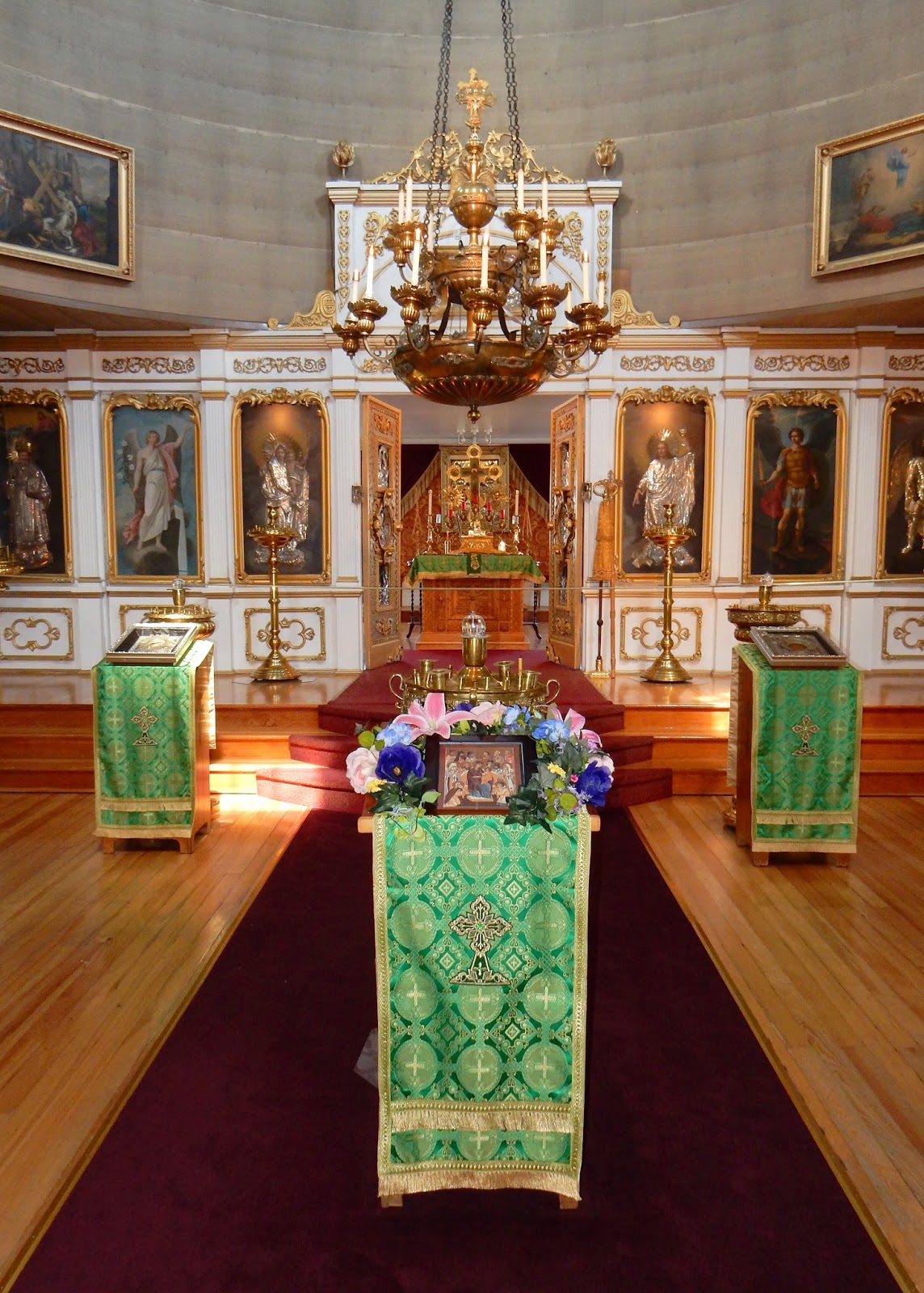
The Iconostasis, or Icon Screen
The Altar Behind the Royal Doors 


The Actual Aleut Gospel Translated by Bishop Innocent

Even more interesting to me was the Russian Bishop’s House, which is a part of Sitka National Historical Park.  This two-story building served as the headquarters of the Russian Orthodox Diocese of Sitka, as well as the residence of the bishop.  Constructed in 1843 by Finnish shipwrights, the building reflects the traditional timber frame construction that was typical of Russian buildings of that era in Sitka.

The Russian Bishop's House - An Ecclesiastical Palace

I’ve said before that I think National Park Service tours are some of the best, and this one was no exception.  Ranger Anne gave us an excellent tour of the upper floor of the building, including the Bishop’s private quarters and chapel.  She elaborated on things that were of particular interest to us, especially the architecture, and her explanations helped us understand the important role of the church in Russian America.

Details from Bishop Innocent's Private Quarters

Public Reception Area

The Bishop's Chapel

One of the few sites that spans all three layers of Sitka’s history is Castle Hill.  This strategic location was once the site of a Tlingit village until the Russians claimed it for their new seat of government.  Several buildings were constructed here, but the most famous one was known as Baranof’s Castle.  Built in 1837, this structure was visible for miles and dominated the Sitka skyline.  In 1867 Castle Hill was the site of the transfer of Alaska from Russia to the United States.  Castle Hill also provides great views of Sitka and the surrounding area.

The View from Castle Hill

There is lots more to discover in Sitka, and I will cover more of the Tlingit heritage and the totem poles for which Sitka is famous in the next post.

June 6, 2015

Onward to Sitka

We had another ridiculously early morning ferry departure from Juneau last Sunday.  Although the ferry did not leave until 6:30 am, we had to check in by 4:30 am.  So, we just decided to check out of the campground the evening before and spend the rest of the night parked in line at the ferry terminal.  I’m not sure which is the better option, but we weren’t too fond of the idea of getting the RV packed and ready to go at 4:00 am.  It’s just something to think about when making ferry reservations.  Often you have no choice with schedules, but every now and then there may be more than one option.

All of our ferry rides to this point had been on the M/V Matanuska, but we picked a fast ferry for the trip to Sitka, and we sailed on the FVF Chenega.  The fast ferries are much newer and do not have cabins, since the sailings are not overnight.  There is also no cafeteria, although there is limited food service.  We were so impressed with the crew on the Chenega, especially the car deck crew members who went out of their way to make sure the RV could safely negotiate the ramp.  One guy even got down on his knees to look under the RV to make sure it cleared the high spots.  We were very appreciative, especially after our unfortunate experience in Wrangell.

Will She Hit the Bottom?
Made It!


We had another beautiful day for sailing, and the trip from Juneau to Sitka is particularly scenic.  We passed another lighthouse, the Point Retreat Light Station that is similar in design to the Five Finger Lighthouse that we passed on the way from Petersburg.  We saw quite a few humpback whales, but I was too slow to get a photo. 

Point Retreat Light Station

Ready to Turn into Peril Strait

We soon turned into Peril Strait and the most stunning part of the trip.  In some ways, the journey through Peril Strait is similar to the one through Wrangell Narrows.  Only small cruise ships and the Alaska ferries can fit.  The strait is also very narrow, and the strong tides can cause issues for any vessel.  In fact, an Alaska ferry hit a rock here in 2004 and almost sank.  Fortunately, we sailed through with no problems.  Peril Strait may be even more beautiful than Wrangell Narrows because it is more unspoiled.  There are very few houses along the water, and there is much more of a wilderness feeling.

Clouds Added Drama to the Trip through Peril Strait

Successfully Navigating Around the Buoys

Views of Nearby Mountains

A Beautiful Passage to Sitka

Unlike the other towns we’ve visited in Southeast Alaska, Sitka is not actually along the Inside Passage.  Located on the west side of Baranof Island, Sitka is somewhat off the beaten path, and consequently fewer cruise ships schedule stops here.  Once the capital of Russian America, Sitka has a long and rich history.

After the ferry docked, we proceeded to our campground.  We will be staying in Sitka for two weeks at the Sitka Sportsman’s Association RV Park, which is located next to the ferry terminal.  The sites are essentially parking spaces in a paved lot, but sites have a nice view of the water and lots of trees line the perimeter.  The full hookups are essential for us for such an extended stay.  A clubhouse with an indoor shooting range is on the property, and it has been a bit disconcerting to hear gunfire during the day.  We have had the place mostly to ourselves, so we have had no problem with close neighbors.  If the park were full, however, the sites would be very tight.

Our View at Sitka Sportsman's Association RV Park

The FVF Chenega on Its Way Back to Juneau

You may be wondering why we are spending two weeks in Sitka.  Tim has a contract with Sitka National Historical Park, and we planned our entire trip through Southeast Alaska around this commitment.  Tim and I are in Sitka to catalog and rehouse a remarkable collection of almost 1,000 glass plate negatives.  These images were taken in the Sitka area by noted photographer E.W. Merrill during the late nineteenth and early twentieth centuries.  I will have much more information about the project in a later post, but it is very exciting to be working with such an invaluable cultural resource.

Welcome to Sitka National Historical Park

After arriving here last Sunday afternoon, we hit the ground running on Monday morning and have been working eight-hour days ever since.  We’re just not used to such hours!  Consequently, we have had no time to explore the town and have had to be satisfied with drive-by views of the downtown area and the historic structures here. 

We have discovered a few good restaurants.  The Larkspur Café offered Sitka’s version of rockfish tacos, and they were very good.  On Friday night we stumbled upon a real find.  We had tried to get into Ludvig’s Bistro, but the tiny place was packed.  

The staff suggested their wine and tapas bar upstairs, so that’s where we headed.  Although there were only a few choices on the menu, every single item we ordered was extraordinary.  A blackened broccoli tapas plate was complementary when ordering a glass of wine, and it was the best broccoli I’ve ever tasted.  The clam chowder was unlike any I’ve ever had– the addition of chorizo gave the chowder just the right amount of spice.  Even the cheese and meat plate was delicious.  I was enjoying myself so much that I forgot to take out the camera.  You’ll just have to take my word for it.  

Perhaps it was because all of this was so unexpected, but we had such a marvelous time.  The food really was some of the best we’ve had in Alaska.  I can’t wait to make a reservation for the bistro and sample the entrees prepared by the same chef.

After one beautiful day following our arrival in town (I knew I should have stopped to take a few photographs!), the rains finally found us.  I think most of Alaska is experiencing the same weather, but it’s a bit of a shock since we’ve been so spoiled for so long by such gorgeous days.  At least for us, we’re working now, so the rain has not interfered with any plans.  It’s still raining today (Saturday), so we decided that sleeping late and taking care of chores and errands would be the way to go.  Even if it’s still raining on Sunday, we are heading out, and I’ll report back on what there is to do in Sitka.

June 5, 2015

Glorious Glacier Bay

I have been fortunate to visit Glacier Bay National Park on two previous occasions, and I consider it to be a very special place.  When Tim and I decided to spend the summer in Alaska, Glacier Bay was near the top of my list of places to visit.  I wanted to return, and I wanted Tim to experience it with me.

Getting to Glacier Bay, however, can be a bit of a challenge unless you are on a cruise ship.  And even then, very few ships are able to snare the necessary permits, since only two large ships can enter Glacier Bay each day.  You can take the ferry from Juneau to Gustavus, the gateway to Glacier Bay, but there are only two departures each week in the middle of the summer, and the only campground is for tents only.  RV travel to Gustavus is strongly discouraged, although it seems to us that there might be some options for boondocking.  Flying is probably the best option, and that is what we decided to do.

Because we did not want to leave Kitty overnight in the RV by herself in Juneau, we had to make our trip to Glacier Bay a day trip.  A very long day trip.  The day started with a 5:30 am flight from Juneau on Wings of Alaska in an eight-passenger plane.  We were in the air for less than a half hour, but we had beautiful views of the Lynn Canal and snow-capped mountains. 

Small Planes Are the Way to Go in Alaska

Glacier Bay Lodge offers an eight-hour tour of Glacier Bay on a high-speed catamaran.  This is the only scheduled day tour permitted inside the park, and we boarded the Baranof Wind at 7:30 am on one of the most perfect days to visit Glacier Bay.   Many people view the park through the fog and mist, but we had a perfectly clear and sunny day.  Our amazing luck continued.

The Baranof Wind Was a Great Boat for a Day Tour

Glacier Bay National Park is the National Park System’s largest protected marine area and is a part of the largest World Heritage Site.  It is a constantly evolving area.  Just 250 years ago, there was no bay in Glacier Bay.  The area was covered entirely by a glacier that was 100 miles long.  Today, that glacier has disappeared, but there are still seven smaller tidewater glaciers that inspire awe in everyone who has the good fortune to see them.

A National Park Service ranger accompanies every boat, including every cruise ship, that enters Glacier Bay.  The ranger who sailed with us was an incredibly knowledgeable naturalist, and he provided insightful commentary about the history of Glacier Bay, as well as wildlife and glaciation.  We especially enjoyed talking with him, and he kept our attention all day.  I have always found presentations by National Park Service rangers to be among the very best out there, and this one was no exception.  

Passing Close to an Island to Search for Wildlife

As the boat made its way into Glacier Bay, we passed very close to several islands where we watched Steller sea lions and harbor seals laze away the day on the rocks.  We had plenty of time to spot tufted puffins and sea otters floating on the bay, and eagles and other numerous species of birds flying above us.  We hugged the coast for a bit and observed a dozen or more mountain goats as they climbed along the steep cliffs.  I especially loved trying to spot the mountain goats, puffins and sea otters.  I can’t decide which of the three I think is the cutest.

Lazy Bums - What a Life!

Wildlife on the Water

Mountain Goats on the Cliffs

When one thinks of John Muir, one typically thinks of Yosemite National Park.  Did you know that Muir traveled to what is now Glacier Bay National Park to help prove his theory that Yosemite had been carved by glaciers, not by the Biblical flood?  He visited the park on three separate occasions and made extensive observations of glaciers.  We visited the spot where Muir was halted by the glacier in 1879.  Today, that glacier has retreated an additional 65 miles, and that is how far we traveled.

Approaching the End of Glacier Bay

The end of the line in Glacier Bay National Park is Grand Pacific Glacier, which is located almost at the Canadian border.  Grand Pacific is a stagnant glacier and not so attractive to look at.  Next to it, however, is the gorgeous Marjerie Glacier, and we spent at least 30 minutes staring at this enormous wall of blue ice.  We were close enough to pick out the intricate shapes and crevices, and anxiously waited for pieces of ice to fall off, or calve.  The glacier is not just a visual delight.  The sound of the calving is thunderous.  It was hard to tear ourselves away.

Marjerie Glacier and Its Massive Ice Field

The Face of Marjerie Glacier

Calving Creates a Thunderous Roar

Beautiful Blue Ice

Waiting in Front of a Glacier for the Perfect Photo Op Can Get a Bit Chilly

But, there was a special treat in store for us after we turned away from Margerie Glacier.  Few people who travel in Glacier Bay are able to see Johns Hopkins Glacier.  It is regarded by many as the most beautiful glacier in the park, but it is often shrouded in fog and is a bit out of the way for most boats.  Because the day was so gorgeous, the captain decided to venture into the Johns Hopkins Inlet and treat us to a view of a glacier that is actually advancing and thickening.  Although we couldn’t get very close because much of the inlet is a critical seal habitat, we still had a grand view.

A Dramatic Setting for Johns Hopkins Glacier

We also passed by Lamplugh Glacier, which Tim actually decided was his favorite.  I’m not sure I can pick mine.  I loved them all.

Lamplugh Glacier

One of the Few Ships We Saw All Day in Front of Lamplugh Glacier

You Can Also See Glacier Bay by Kayak, and the Boat Will Pick You Up

Although it was a very long day, I loved every minute of it (well, maybe not all of the racket from some of the children on board), and I would highly recommend this boat tour to anyone.  It would be nice if you had time to spend the night at the lodge, or one of the inns in Gustavus, but we were fine with flying back to Juneau late in the afternoon.  The light was even better on the return flight, and we were treated to a view of Mendenhall Glacier and its lake from the air.  That was a fitting end to a day in Glacier Bay National Park.

View of Excursion Inlet on the Flight Back to Juneau

Mendenhall Glacier and Its Ice Field from the Air

At the beginning of this post I said that Glacier Bay National Park is a special place, and I still consider it to be so.  It’s not only because of the presence of magnificent glaciers or plentiful wildlife.  You can still see those things at other places in Alaska and elsewhere.  What makes Glacier Bay so special is that it is a wilderness area that the National Park Service zealously tries to protect.  In order to keep the wilderness experience as pure as possible, the number of boats that may enter the park is highly restricted.  For most of the day, we saw not one other boat on the water.  It was as though we had this magnificent place all to ourselves.  It may be costly to visit this park, but it was worth every penny.